

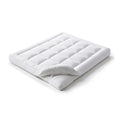


A duvet goes in its cover with its width matching the cover's width and its length matching the cover's length. On a UK king or super king, the longer side of the duvet runs across the bed, not down it: a king duvet is 225 cm wide and 220 cm long. A double is a 200 cm square, so it fits either way round. The stitch lines don't follow one rule, because every maker stitches differently. Below: each size, the label, stitching types, and a quick check.
| Size | Duvet (width x length) | Our cover (width x length) | Which side is longer? |
|---|---|---|---|
| Single | 135 x 200 cm | 137 x 200 cm | Length, so the long side runs down the bed |
| Double | 200 x 200 cm | 204 x 204 cm | Neither, it's square |
| King | 225 x 220 cm | 235 x 225 cm | Width, by 5 cm |
| Super king | 260 x 220 cm | 265 x 225 cm | Width, by 40 cm |
Duvet sizes are for our microfibre duvet. Cover sizes are for our duvet cover sets.
Do duvet lines go across or down?
Duvet lines don't go one fixed way, because the stitching changes from maker to maker. Bensons for Beds says every duvet manufacturer differs in stitching, so the lines aren't always a reliable guide to which way is right.
Soak&Sleep, a UK duvet maker, suggests laying the duvet on the bed with the long edges running lengthwise to see which way its lines should point. That works on a single. It gets confusing on a king or super king, where the long edges are the top and bottom, not the sides.
So we'd ignore the lines and go by the measurements. If the duvet's width matches the cover's width, the lines are where the maker put them.
Which UK duvet sizes are square and which are rectangular?
A UK double duvet is square, at 200 x 200 cm, while singles, kings and super kings are rectangles. A single is longer than it is wide, but a king and a super king are wider than they are long.
Bensons gives the same pattern: a single at 135 x 200 cm, a double at 200 x 200 cm, a king at 230 x 220 cm and a super king at 260 x 220 cm, all width first. Our king is 225 x 220 cm. Brands write the numbers in different orders, so our duvet size guide explains which figure is the width.
The single is the easy one. Its sides are 65 cm longer than its top and bottom, and you can see it straight away. The king is the hard one, because 5 cm is hard to spot by eye.

How do you tell which way a double duvet goes?
You don't need to: a 200 x 200 cm double duvet is square, so it fits its cover either way round. Bensons says that with a double you can't really go wrong, because the top and bottom are the same length as the sides.
If you want the same edge at the top every time, use the label. Soak&Sleep suggests a small stitch or a light pen mark on the top edge if there isn't a label to go by.
Which side of a duvet is the top?
The top of a duvet is the edge that sits under your pillows, and on most duvets the label tells you which end that is. Bensons says the vast majority of duvets have a set top and bottom, usually shown by the label.
On a king or super king, the top and bottom are the two longer edges. On a single, they're the two shorter ones.
Where should the duvet label go?
The duvet label goes wherever your duvet's maker says, because UK guides disagree. Bensons says the label always goes at the foot of the bed, lined up with the cover's opening. Soak&Sleep says a manufacturer's label goes at the head.
Soak&Sleep also puts the care labels on its own duvets on the side edges. That's three positions from two brands. So treat the label as a marker for your duvet only: once you know which end it belongs at, put it there every time.
What is the difference between channel and box stitching?
Channel stitching is a set of long parallel lines that divide the duvet into strips, while box stitching divides it into squares. Box stitching holds the filling in place better, and channels show a direction you can read.
Canadian Down & Feather, a down bedding maker, says box construction is preferred to channels because it keeps the filling evenly spread, and that without it parts of the duvet end up with little or no fill. The VDFI, Germany's down and feather industry association, describes box duvets in layouts such as 3 x 4 or 4 x 6 boxes.
A grid of squares looks much the same from every side, which is another reason to go by size. Our microfibre duvet has stitched channels that keep the hollowfibre filling spread out.
What happens if a duvet goes in sideways?
A sideways duvet leaves empty gaps in the cover and bunches up elsewhere. Bensons says putting a king duvet in the wrong way round can leave gaps where the cover has no duvet inside at all, and makes the duvet less comfortable.
Here's what that looks like with our sizes. A super king duvet put in sideways is 220 cm across in a 265 cm wide cover, so 45 cm of the cover's width is empty. Its 260 cm then has to fit a 225 cm length, so 35 cm folds up at the foot.
A sideways king is a smaller problem. It leaves 15 cm of empty width instead of 10 cm and fills the full 225 cm length with no spare. A sideways single won't go in at all: 200 cm doesn't fit a 137 cm wide cover.

How do you check a duvet is the right way round in its cover?
Check the duvet by matching its longer edges to the cover's longer edges before you put it in. Lay the cover flat, compare the edges, and only then fasten it. Here are the 5 steps:
- Find the duvet's longer pair of edges. Measure them if the duvet is a king, since the difference is only 5 cm.
- Lay the cover flat with its opening at the foot of the bed. Bensons and Soak&Sleep both put the opening there.
- Line up the duvet's longer edges with the cover's longer edges: down the bed for a single, across it for a king or super king.
- Turn the labelled end to whichever end your duvet's maker gives.
- Put the cover on with the shake method or the roll method, then fasten the opening.
Our guide to zip and button duvet covers has the full burrito steps. After that, smooth the duvet into the corners. If one side has an empty flap of cover, take it out and turn it a quarter turn. If it still slides about, our guide on how to stop a duvet bunching has 8 fixes.
Which Adam Home duvet fits which cover?
Each Adam Home duvet fits the cover with the same size name: a king duvet goes in a king cover. Our covers are cut slightly larger than our duvets, from 2 cm wider on a single to 10 cm wider on a king, so the duvet has room to sit inside.
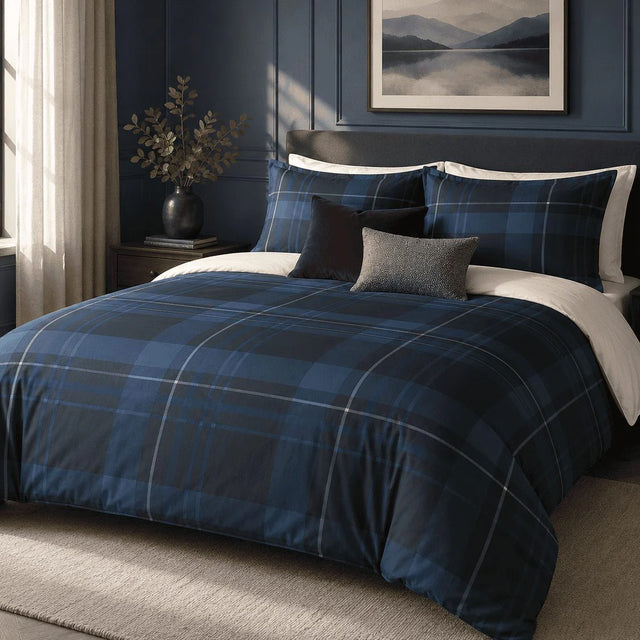
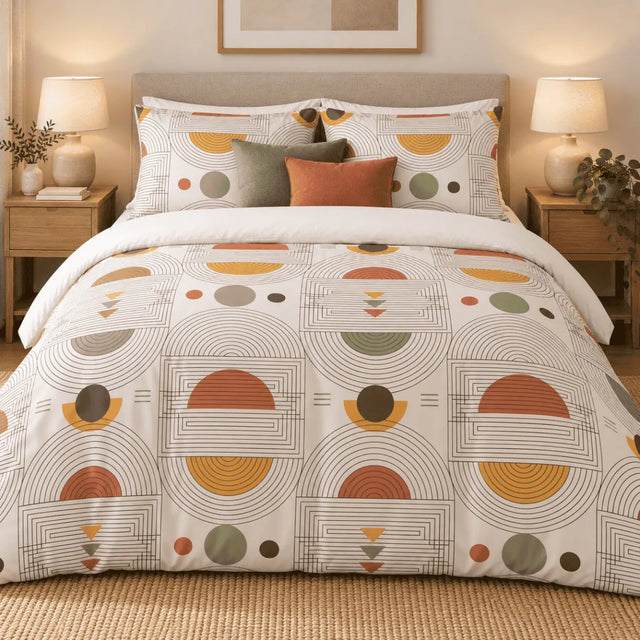
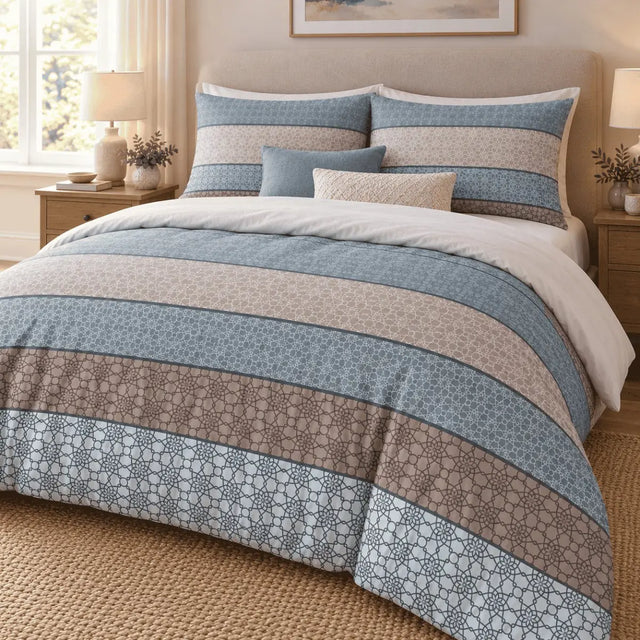
Our microfibre duvets come in single, double, king and super king, in togs from 1 to 15, from £15.99. Our duvet cover sets are polyester microfibre with a snap-button opening, designed and made in the UK, from £26.99 for a single. Each set has a duvet cover and pillowcases, and the duvet is sold separately. Our guide to what comes in a duvet cover set lists the pieces by size.
The sets are grouped by pattern, including abstract duvet covers, bohemian stripe duvet covers, brushstroke duvet covers and textured stripe duvet covers. Our duvet cover size chart gives each size in cm.
Written by the Adam Home team in the UK.