
Plaid and tartan are the same pattern in most everyday use, but the words come from different places. Tartan is the Scottish design of coloured stripes that cross at right angles and repeat. Plaid comes from the Scottish Gaelic word for a blanket, and in North America it's the usual word for tartan and for checked cloth in general. Check is the wider family of crossed lines that form squares, and gingham is a simple two-colour check. Below: a definition of each, a comparison table and tips for a bed.
Is plaid the same as tartan?
Plaid and tartan often mean the same pattern, but they aren't quite the same word. In Scotland, plaid first meant a rectangular garment or blanket, sometimes made of tartan cloth. In North America, plaid is the common word for tartan itself.
So every tartan is a plaid in the American sense, but not every plaid is a tartan. Merriam-Webster's Collegiate defines plaid broadly as a pattern of stripes of different widths that cross to form squares, and that covers plenty of designs with no Scottish link at all. Both words have a long history in Scottish English. The Oxford English Dictionary's first example of plaid is from 1510, and its first definite example of tartan is from 1533.
What is tartan?
Tartan is a woven design of two or more coloured stripes that alternate and cross vertically and horizontally to form a repeating chequered pattern. That's close to the wording of the Scottish Register of Tartans Act 2008, the law behind Scotland's official register.
The repeating unit of a tartan is called its sett. In most setts the order and width of the stripes is the same in the warp (the long threads) as in the weft (the threads across), so the pattern is symmetrical. Traditional tartan is woven in a 2/2 twill of worsted wool, and where 2 colours cross, the eye reads a third, blended shade.
The register was set up by an act of the Scottish Parliament in November 2008 and opened on 5 February 2009. It holds thousands of designs. Many tartans are linked to a surname or clan, but the register's own advice is that there are no laws about which tartan you can wear, only traditions.
What is plaid?
Plaid is a pattern of coloured stripes of different widths that cross each other to form squares. In the US and Canada it's the everyday word for tartan, and for tartan-like checks that aren't registered Scottish designs.
The word comes from the Scottish Gaelic plaide, meaning blanket. In the Highlands it named a length of cloth worn wrapped around the body, like the belted plaid that came before the modern kilt, and later the blankets themselves. So when a Scot says plaid, they may mean the garment, not the pattern.
Plaid as a pattern word is loose. Buffalo plaid, the big red and black block design, is known in Scotland as the Rob Roy tartan.
What is a check pattern?
A check is any pattern of crossed horizontal and vertical lines that form squares. It's the widest of the 4 terms. Tartan, plaid and gingham are all checks, and so are houndstooth, Tattersall, windowpane and shepherd's check.
In British English, check is the plain, general word, often with no claim to Scottish roots. A check can be 2 colours or many, tiny or large, woven or printed.
What is gingham?
Gingham is a balanced, plain-woven fabric in a two-colour check, usually white and one bright colour, made from dyed cotton or cotton-blend yarns. It's also called Vichy check, after the French town.
The name may come from the Malay word genggang, or from Guingamp, a town in Brittany. Gingham reached Europe in the 17th century as a striped cloth. From the mid-18th century the mills of Manchester wove it in checks, often blue and white, and checked gingham became the version we know. In the UK it's a familiar pattern on younger girls' school uniforms.
Look closely at a gingham and you'll see 3 tones: solid colour where 2 coloured stripes cross, white where none run, and a lighter mid-tone where only one does.
What is the difference between check and gingham?
Check is the whole family of crossed-line patterns, and gingham is one specific check: small, even squares in white plus one colour. Every gingham is a check, but a check can have many colours, uneven stripes or a large scale, and then it isn't a gingham.
If the pattern has 3 or more colours, or lines of different widths, call it a check or a plaid. If it's one colour on white in a neat, regular grid, it's gingham.
How do the 4 patterns compare?
Tartan is the strictest of the 4, a woven Scottish sett. Plaid is the American catch-all, check is the general family, and gingham is the simplest two-colour check.

| Pattern | Origin of the word | How it's made | Colours | Lines and symmetry | Typical use |
|---|---|---|---|---|---|
| Tartan | Scottish English, from 1533 | Traditionally woven, 2/2 twill in wool | 2 or more, crossing to make blended shades | Mixed stripe widths; same sett across and down; most setts symmetrical | Kilts, scarves, blankets, Christmas textiles |
| Plaid | Scottish Gaelic plaide, blanket; Scottish English from 1510 | Woven or printed | 2 or more | Stripes of different widths crossing to form squares | Shirts, throws, bedding; in Scotland, a wrapped garment |
| Check | General English term | Woven or printed | Any number | Horizontal and vertical lines forming squares, any scale | Uniforms, shirts, suits, tablecloths |
| Gingham | Malay genggang or Guingamp, Brittany | Plain weave from dyed cotton or cotton-blend yarn | White plus one colour | Small, even squares in a balanced grid | Summer dresses, school uniforms, tablecloths, bedding |
The table describes the traditional cloth. Today the patterns are no longer limited to weaving and turn up printed on paper, wall coverings and bedding, so a printed duvet cover can carry any of them.
How do you use plaid, tartan, check and gingham on a bed?
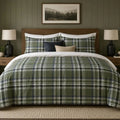
Use one checked pattern as the star on the duvet cover, then calm it with plain sheets, pillows or a throw in one of its colours. Scale matters most: one large and one small pattern sit together better than 2 of the same size.
A few ways that work:
- Plaid with plain white. All our plaid and gingham covers have a plain white reverse, so you can fold the top back to show white and frame the pattern.
- Pick out the thinnest line. A plaid's fine overcheck, say a pink line through teal, is the colour to use for a cushion or throw.
- Gingham for a small room. A small, even gingham reads as texture from a distance, so it looks calmer than a big plaid in a box room or a child's room.
- Tartan for winter. Red tartan with cream knits and wood is the classic Christmas bed. Our guide to Christmas duvet covers has more seasonal sets.
- Don't stack checks of the same scale. A plaid duvet with a gingham pillowcase of similar square size tends to fight. Keep one of them plain.
For the order of sheets, duvet and throws, our guide to layering a bed walks through each layer.
Which plaid, tartan and gingham duvet covers do we sell?
We sell 15 plaid duvet cover sets and 8 gingham duvet cover sets, all from £26.99 for a Single. They're printed designs, not woven cloth: the pattern is printed on the front of 100% polyester microfibre, and the reverse is plain white.
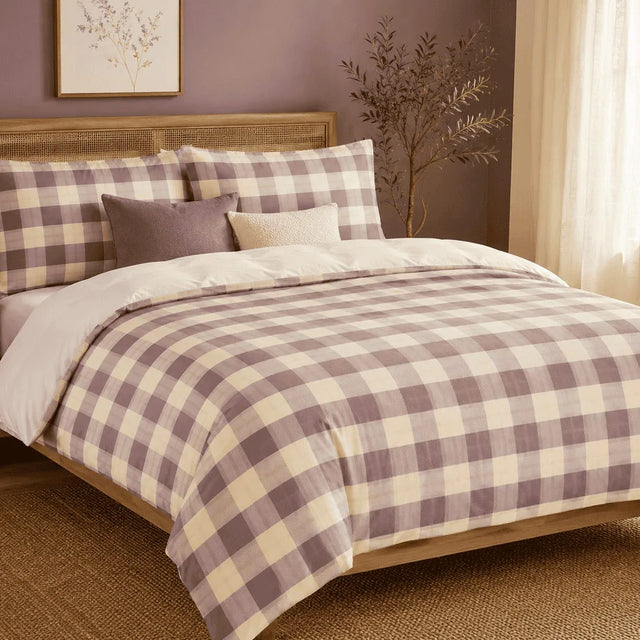
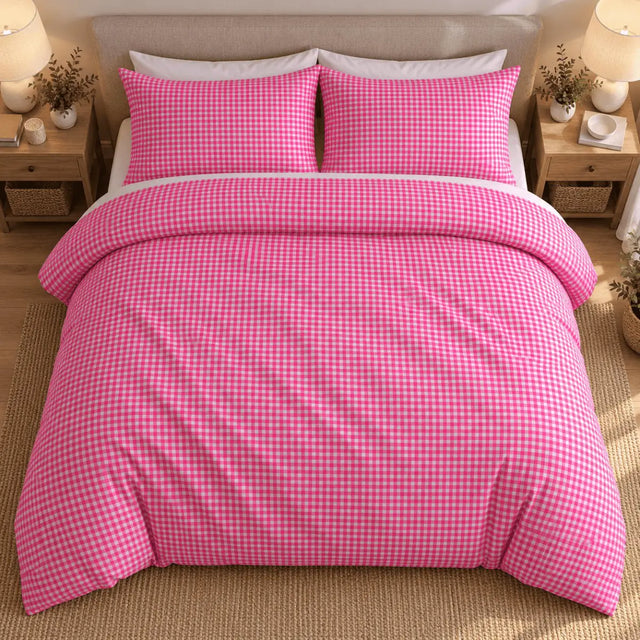
The plaids run from big buffalo-style blocks, like the lavender and cream, to fine overchecks, like the teal with a pink line. The ginghams are small, even checks in white or cream plus one colour, from navy and royal blue to mustard, olive and hot pink. For Christmas there's the tartan snowflake Christmas duvet cover set, a red tartan with small white snowflakes in each square.
The plaid range also includes olive plaid, pink plaid, green plaid, blue plaid, beige plaid, mocha plaid, sand plaid and midnight plaid sets.
Every set is designed and made in the UK and closes with snap buttons. Sizes run Single, Double, King, Super King and Emperor, and each set comes with 54x77 cm pillowcases: 1 with a Single and 2 with the larger sizes. The duvet itself isn't included. Our guide to microfibre bedding explains how the fabric feels and washes.
Written by the Adam Home team in the UK.