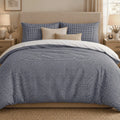
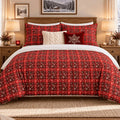
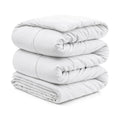

The best filling for a duvet is down if you want the lightest duvet for its warmth, and polyester (hollowfibre or microfibre) if you want one you can wash at home and that suits allergies. Feather gives a heavier feel, wool suits people who get hot in the night, and silk is a natural option for people happy to spot clean. Warmth itself comes from the tog rating, not the filling type. This guide compares the six fillings, explains what separates hollowfibre from microfibre and feather from down, and covers allergies and washing for each one.
| Filling | Warmth for weight | Allergies and washing | Best for |
|---|---|---|---|
| Hollowfibre (polyester) | Same warmth as natural at the same tog, but can weigh more than high down | Non-allergenic, machine washable | Allergy sufferers and washing at home |
| Microfibre (polyester) | Same as hollowfibre: same tog, same warmth | Non-allergenic, machine washable | A soft, silky feel that washes easily |
| Feather | Feels heavy, lowest fill power of the natural fills | Professional laundering usually advised | People who like a weighty duvet |
| Down | Lightest for its warmth, higher fill power insulates more | Professional laundering usually advised | The lightest duvet at a given tog |
| Wool | Regulates temperature, helps you stay cool | 30°C wool cycle only, never tumble dry | Hot sleepers who want a natural fill |
| Silk | Sold up to winter weights, such as 8 to 10 tog | Often spot clean or hand wash only | A natural duvet kept in a washable cover |
The warmth, allergy and washing notes come from John Lewis's duvet buying guide and the care pages of Devon Duvets, Belledorm and a John Lewis silk duvet. Always follow the label on your own duvet.
What is the best type of filling for a duvet?
The best type of filling is the one that matches your main priority: down for low weight, polyester for easy washing and allergies, wool for staying cool, and feather for a heavy feel.
What filling doesn't decide is how warm the duvet is. That's the tog's job. John Lewis says synthetic duvets "give you the same warmth as a natural-filled style" at the same tog. So pick the tog for your bedroom first, using our guide on which tog duvet suits each season, then pick the filling for weight, feel and care.
If nobody has allergies and you don't mind a laundry bill, down is lovely to sleep under. For most families, a polyester duvet that goes in the washing machine is the more practical pick.
Is a microfibre duvet good quality?
Yes, a microfibre duvet is good quality for most people: it's as warm as a natural duvet of the same tog, non-allergenic and machine washable. Its weak spot is weight, because it can be heavier than a high down duvet.
Quality comes down to construction more than the word on the label. A duvet with stitched channels or boxes holds its filling in place, while an unstitched one lets the filling drift to the edges and leave thin patches. Microfibre as a fabric has its own pros and cons, which our guide to whether microfibre bedding is good sets out.
What is the difference between hollowfibre and microfibre?
Hollowfibre and microfibre are both polyester. Hollowfibre is polyester spun with a hollow core that traps air inside each strand, and microfibre is polyester spun finer than 1 denier.
So the difference is the shape and thickness of the strand, not the material. Microfibre strands are under 10 micrometres across, which gives a soft, silky handle. Hollowfibre is springier, and the hollow core adds loft. Retailers often use the names loosely, and a duvet sold as "microfibre" can have a hollowfibre filling. Ours does, which we explain at the end. For how the hollow core is made, read our guide to hollowfibre.
Are synthetic duvets warm?
Yes, synthetic duvets are warm. Tog measures thermal resistance whatever the filling, so a 13.5 tog polyester duvet keeps you as warm as a 13.5 tog down one.
The difference is how much filling it takes to get there. Down traps more air per gram, so a high down duvet reaches the same tog with less weight. If you like to feel the duvet on you, the extra weight of a synthetic is a plus.
What is the difference between feather and down?
Down is the soft, fluffy layer that grows under a bird's outer feathers, with a vestigial shaft and no hooks on its barbules. Feathers have a stiff central quill, so they feel heavier and firmer.
Under BS EN 12934, the British and European standard for feather and down labelling, the down and feather percentages must be stated by weight, in decreasing order and rounded to groups of 10%. A label reading 90% down, 10% feather is mostly down. One reading 85% feather, 15% down is mostly feather, a blend once sold in the UK as "feather and down". The word "pure" with a bird species, such as pure goose, is only allowed when that species makes up at least 90%.
Fill power is the other number to look for. It measures loft, the volume a fixed weight of down fills, in cubic inches per ounce. Wikipedia gives a range from about 300 for feathers to around 900 for the best goose down, and a higher number means more warmth for the same weight.

Which duvet filling is best for allergies?
A synthetic filling is best for allergies, because the NHS advice for dust mite allergy is to use synthetic bedding and covers and wash bedding regularly at 60°C or above.
Allergy UK says washing at 60°C or above kills mites, and that cooler washes remove allergen only for a while. It also recommends breathable barrier covers that fully enclose duvets and pillows. Dust mites, not feathers, cause most bedding allergy: Wikipedia cites a Finnish study that found true feather allergy rare.
Feathers can still cause trouble for a few people. In 2019, doctors in BMJ Case Reports described a man who developed a lung condition, "feather duvet lung", after swapping synthetic bedding for feather. He recovered after going back to synthetic. The authors said it isn't known how common this is.
How do you wash each type of duvet filling?
Synthetic duvets go in the washing machine on a gentle cycle, wool needs a 30°C wool cycle, feather and down are best laundered professionally, and silk is usually spot clean or hand wash only.
Belledorm says feather and down may need the dry cleaner, and if the label allows a machine wash, use a gentle cycle and non-bio detergent. Devon Duvets says never tumble dry a wool duvet. A John Lewis mulberry silk duvet is spot clean only, and Belledorm's silk and polyester duvet must be hand washed. Drum size matters for all of them: AO.com's washing machine expert told Ideal Home that a double or king duvet needs at least a 9 kg drum. Our step-by-step guide to washing a duvet covers the method.

Are wool and silk good duvet fillings?
Wool and silk are good fillings for people who want a natural duvet without feathers. Wool is known for keeping you cool, and silk duvets are sold up to winter weights.
John Lewis says wool is "particularly good at regulating your temperature" and calls it naturally hypoallergenic. Silk is the hardest to clean, so it suits a bed where the duvet always stays in a washable cover.
What filling does the Adam Home duvet use?
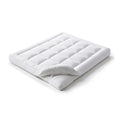
The Adam Home duvet uses a hollowfibre filling: hollow polyester fibres made as a down alternative, with no feathers. We sell it as our microfibre duvet, and the fibre inside is hollowfibre.
The microfibre duvet has stitched channels to stop the filling bunching, and it's machine washable. It comes in 1, 2.5, 4.5, 7.5, 10.5, 13.5 and 15 tog, in single, double, king and super king (the 1 tog in double and king only), and weighs around 1.2 to 2.2 kg depending on size. Prices start from £15.99 for the 1 tog double. The product page doesn't give a wash temperature, so check the label before a hot wash.
Written by the Adam Home team in the UK.