



Back sleepers need a medium pillow about 7.5 to 13 cm (3 to 5 inches) high, and front sleepers need a very thin one under 7.5 cm (3 inches) or no pillow at all, according to the Sleep Foundation. Pillow height, or loft, is the thickness of a pillow lying flat before your head presses it down. The right loft keeps your head in line with your spine. On your back, too much of it pushes your head forward. On your front, it bends your neck back and up. The sections below cover the height and firmness back sleepers need, whether one pillow is enough, whether front sleepers need a pillow at all, where a hip pillow goes, and which of our pillows match each position.
| What to check | Back sleepers | Front sleepers |
|---|---|---|
| Pillow height | 3 to 5 in (about 7.5 to 13 cm) | 3 in (about 7.5 cm) or less, or none |
| Firmness | Medium | Soft |
| Pillows under your head | One | One very thin pillow, or none |
| Extra pillow | Under the knees | A thin pillow under the pelvis |
| Bounce Back firmness | Medium | Soft |
The heights come from a Sleep Foundation pillow guide reviewed by a physical therapist, converted from inches and rounded (3 in is 7.6 cm, 5 in is 12.7 cm). Side sleepers need a pillow that fills the gap between head and mattress, and our guide to pillows for side sleepers covers that position.
What pillow height suits back sleepers?
A pillow 3 to 5 inches thick, about 7.5 to 13 cm, suits back sleepers, according to the Sleep Foundation. Its medically reviewed page on back sleeping says a medium-loft pillow that fills the space between your neck and the mattress can stop your head tilting too far forward or backward.
The Sleep Charity gives a check you can do without a ruler. Your head should sit in the same line with your shoulders and spine as it does when you stand up straight with good posture. Ask someone to look at you from the side while you lie on the pillow. If your head tips forward or back compared with standing, the height is wrong.
To measure loft, lay the pillow flat on the bed and measure its full thickness before you press on it. That's how the Sleep Foundation's testers grade loft. The testers class anything under 3 inches (7.5 cm) as low loft, 3 to 5 inches as medium and over 5 inches (13 cm) as high.

Should back sleepers use a firm or soft pillow?
Back sleepers do best on a medium pillow, neither soft nor firm, the Sleep Foundation says. Firmness decides how much of a pillow's loft is left once your head sinks in.
The Sleep Charity explains what goes wrong at each end. A pillow that's too soft lets the head flop and curves the neck. One that's too hard can leave you with a crick in the neck.
If you already have neck pain, the NHS neck pain page advises a low, firm pillow.
Do back sleepers need one pillow or two?
One pillow under your head is enough for a back sleeper, according to a Cambridge University Hospitals NHS leaflet, which says a single pillow stops your head tilting to the side, forwards or backwards.
The same leaflet suggests moulding the filling so it supports your neck where it dips in below your head, with a towel or a second pillow there if you need more. A second pillow can also go under your knees. The Sleep Foundation suggests one there to ease tension in the lower back, with your knees slightly bent and comfortable.
Back sleeping makes snoring more likely, the Sleep Foundation and The Sleep Charity both say. If you snore, the Sleep Foundation suggests raising your head with a second pillow.
Should front sleepers use a pillow?
Front sleepers should use a very thin pillow or none at all, according to the Sleep Foundation's medically reviewed page on stomach sleeping. Its pillow guide sets the limit at 3 inches, about 7.5 cm, and says front sleepers suit a softer pillow.
The reason is the neck. Lying face down, you have to turn your head to one side to breathe, and that twists your neck out of line with your spine. The thicker the pillow, the more strain your neck takes, the Sleep Foundation says.
NHS advice goes further and steers people off their front altogether. The NHS neck pain page lists not sleeping on your front as one way to prevent neck pain. An NHS Borders physiotherapy leaflet says stomach sleeping can increase the strain on your neck over time.
Front sleepers are in the minority. A 2017 study in Nature and Science of Sleep fitted 664 working adults with accelerometers and found they spent 7.3% of their time in bed on their front, against 37.5% on their back and 54.1% on their side.
Where should a front sleeper put a pillow?
A front sleeper should put a thin pillow under the pelvis, between the lower abdomen and mid-thigh, the Sleep Foundation advises. Without it, the torso sinks into the mattress and the lower back can arch out of its neutral line.
The mattress plays a part too. For front sleepers, the Sleep Foundation recommends a mattress on the firmer side with just enough give, usually rated medium to firm.

How do you stop sleeping on your front?
To stop rolling onto your front, put firm pillows, extra blankets or a long body pillow along either side of your body. That's the Sleep Foundation's tip for training yourself into a new position.
Pregnancy is one reason to switch. The Sleep Foundation says pregnant people should avoid sleeping on their stomach, and the NHS advises going to sleep on your side, left or right, after 28 weeks of pregnancy. Our guide to body pillow benefits and how to sleep with one compares the straight, C and U shapes.
Which of our pillows suit back and front sleepers?
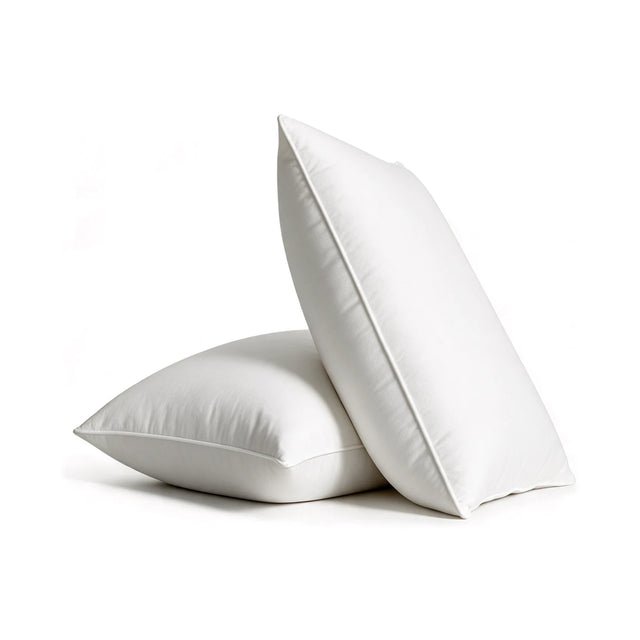
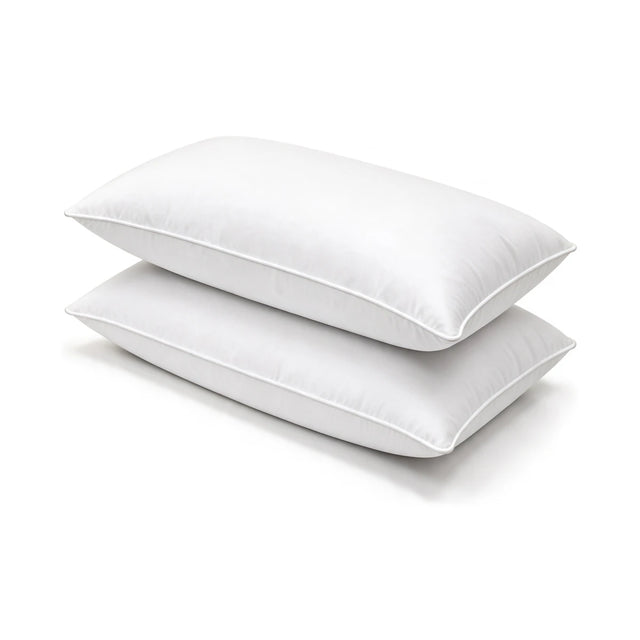
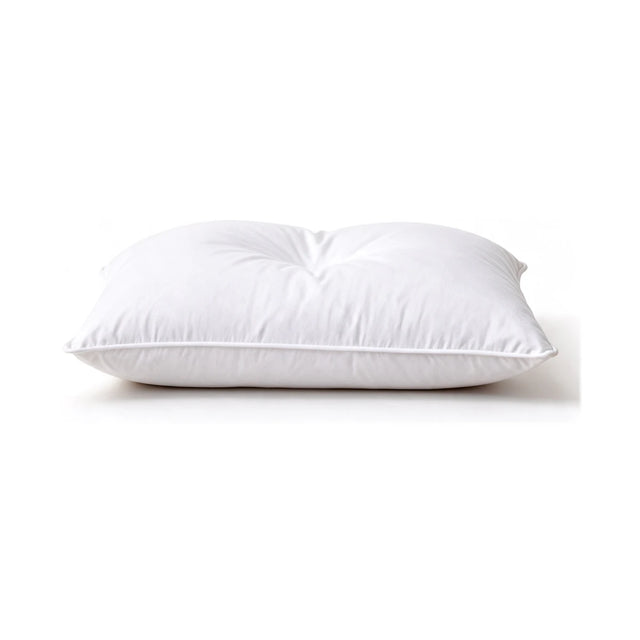
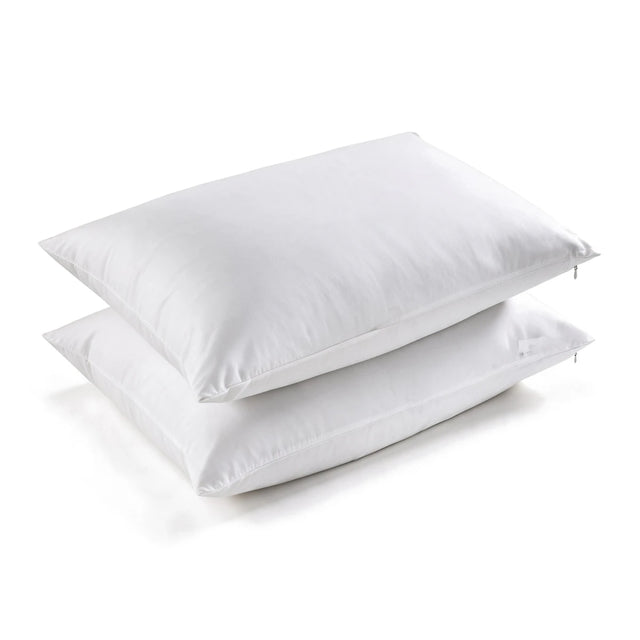
Our Bounce Back pillows suit both, because they're the only pillows we sell in soft, medium and firm. The listing matches them to how you sleep: soft for stomach sleepers, medium for backs and firm for side sleepers.
Both soft and medium pillows in the range have virgin hollowfibre inside a 100% brushed cotton, down-proof cover, in packs of 2 or 4. A 2 pack costs £12.99 in medium and £17.99 in soft, and a 4 pack costs £18.99 in medium and £26.49 in soft.
| Pillow | What the listing says | Size | From |
|---|---|---|---|
| Bounce Back Medium | Medium for backs | Standard UK | £12.99 for 2 |
| Bounce Back Soft | Soft for stomach sleepers | Standard UK | £17.99 for 2 |
| Hotel Quality | Medium support, suits side and back sleepers | 48x74 cm | £11.99 for 2 |
| Quilted | Suits stomach, back and side sleepers | 48x74 cm | £8.99 for 1 |
None of our listings gives a loft in centimetres, so measure a new pillow flat, as above, and see where it sits against the 7.5 cm and 13 cm marks. Every pillow here fits a standard UK pillowcase, and our chart of UK pillow sizes explains the 48x74 cm standard. The Bounce Back, Hotel Quality and Quilted pillows all go in the washing machine, and our guide on how to choose a pillow compares filling and care across the whole range.
Written by the Adam Home team in the UK.