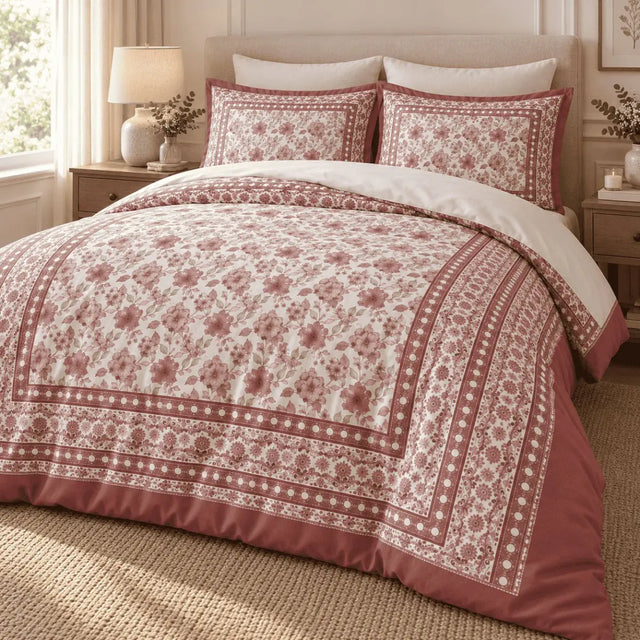




Botanical bedding is any duvet cover, sheet or pillowcase printed with plants: flowers, leaves, stems, vines or berries, sometimes drawn in the style of an old botanical illustration. It sits between a plain bed and a fully patterned room, and it looks best with one print on the bed and plain colours taken from that print around it. This guide covers what counts as botanical, how floral, leaf and illustration prints differ, which colours go with them, how to pair them with plain sheets and throws, how to match the print to your room, and seven styling rules to finish.
What is botanical bedding?
Botanical bedding is bedding with a plant print, such as flowers, leaves, vines or berries. Some designs copy the fine detail of botanical illustration. Most are looser florals or simple leaf shapes.
Wikipedia defines botanical illustration as "the art of depicting the form, color, and details of plant species", drawn to describe a plant accurately. Bedding rarely goes that far. In shops, botanical covers almost any print where a plant is the main motif.
The plant prints most British bedrooms know come from William Morris. The V&A says his first wallpapers had designs "inspired by English gardens and hedgerows". His Strawberry Thief, designed in 1883, shows birds, strawberries and flowers, block-printed on cotton for curtains or for draping around walls. A lot of floral bedding still borrows that dense, trailing, all-over look.
What is the difference between floral, leaf and botanical illustration prints?
Floral prints put flowers first. Leaf prints use foliage or leaf shapes with few or no flowers. Botanical illustration prints draw single plants in detail on a lot of plain background.
| Print type | What you see | How busy it looks | Adam Home example |
|---|---|---|---|
| Floral | Blooms, sprigs, rosettes and trailing vines | Medium to very busy, depending on scale | Framed Heritage and floral patchwork sets |
| Leaf | Leaves or leaf shapes, little or no flower | Calm to medium, often reads as a stripe | Peach Sage Leaf Stripe |
| Botanical illustration | One plant per motif, drawn in detail, lots of plain space | Calm | None at the moment |
We don't sell a design called botanical, but most of our 13 Framed Heritage designs are florals with a border, like a framed coverlet. Ivory Rose has small dusty rose blossoms and sage-green leaves inside a tight floral border. Royal Blue is a dense trailing floral of blue blooms and navy stems on white. Navy Cornflower has small bouquets of bell flowers on navy, framed by a wide cornflower border. Other Framed Heritage designs include the Lilac Plum, Sand Coral and Teal Gold sets. You'll find them all with our floral duvet cover sets.
The patchwork duvet covers include three floral sets. Indigo Floral prints white vines and sprigs on indigo patches, like a block-printed quilt. Rustic Floral mixes white poppies on black vines and ditsy florals over a tan ground of falling leaves. Midnight Floral scatters tilted squares of tiny aqua, coral and olive flowers across black.
For leaves without flowers, our leaf print duvet cover set stacks tapered leaf shapes in peach, tan, grey-sage and charcoal in vertical columns on cream, so they form soft stripes from pillow to foot.
All of these are printed on the front of 100% polyester microfibre with a plain white reverse and snap buttons, designed and made in the UK. Each set comes in Single to Emperor, from £26.99. Our guide to what microfibre bedding is explains the fabric.

What colours go with botanical bedding?
The colours that go best with botanical bedding are the ones already in the print. Pick one or two shades from the flowers or leaves, repeat them in plain sheets or pillowcases, and let white, cream or grey carry the rest.
Ideal Home's advice for florals is to "pick out the colours in the pattern" and use blocks of that colour elsewhere in the room. Designer Michelle Murphy, speaking to Livingetc, suggests grounding bold bedding with neutrals such as white, cream or grey in the walls, furniture or rugs.
Green is the easy one. Livingetc's designers pair sage and forest greens with terracotta as an earthy, nature-led combination, and suggest delicate florals for a soft blue and white bed. So a green leaf or a blue flower in your duvet cover is a ready-made colour scheme.
Our extra deep fitted sheet comes in six plain colours: beige, black, charcoal, navy blue, silver grey and white, from £8.99. Here's how they line up with our floral and leaf designs.

How do you pair botanical bedding with plain sheets and throws?
Keep the duvet cover as the only print on the bed. Choose plain sheets and pillowcases in a colour from the design, then add one textured throw in a neutral or a second shade from the print.
Interior designer Anna Haines told Homes & Gardens she starts with one larger-scale design, adds a smaller pattern or a stripe that picks up its colours, then "one or two textured plains, such as a slubby linen or a mohair". Designer Ainsley Stewart puts it more simply: a pattern looks prettiest next to a solid.
Our sets come with matching printed pillowcases, so the print is already on the pillows. Behind them, plain cases add depth. Our plain pillowcases come in packs of two in six colours, though at 48x74 cm they're smaller than the 54x77 cm cases in our sets. The plain white reverse of the cover helps too: fold the top back and the white band links the print to a white sheet.
For the throw, Livingetc suggests velvet, linen or knit to stop printed bedding looking flat. Our guide to how to layer a bed covers the order from mattress to throw.
How do you match botanical prints to your room style?
Match the print to the room by scale and background colour. Framed, dense florals suit traditional and cottage rooms with wood. Spaced leaf shapes suit mid-century rooms. Dark-ground florals suit deeper, moodier schemes.
Our own design notes follow that pattern. Sand Coral, with its border of trailing leaves and berries, is made for jute rugs, washed oak and a country-cottage bedroom. Ivory Burgundy's block-print rosettes suit dark wood and brass lamps. The Peach Sage Leaf Stripe is a mid-century look for warm neutrals and oak bedside tables. Midnight Floral works with dark wood, rattan and navy.
In a modern room, Ideal Home says florals work in contemporary schemes as long as walls and floors stay pared back so the pattern isn't fighting for attention. If you'd like a second pattern, interior designer Tara McCauley mixes florals with geometrics and stripes, and varies their scale so they don't compete. A small check cushion next to a floral duvet is one way to do it, and our guide to plaid vs tartan explains the check patterns.
How do you style botanical bedding?
Style botanical bedding with seven rules: one print on the bed, plain colours taken from the print, a neutral, one texture, a second pattern at a different scale, one repeated colour, and quiet walls.
- Keep one print on the bed. Michelle Murphy's advice to Livingetc is to keep one piece bold and let the rest support it. With a floral duvet cover, that piece is the cover.
- Take plain colours from the print. Pick the second or third colour in the design, not the background, for sheets or pillowcases.
- Add a neutral. White, cream or grey around the bed stops a busy floral taking over.
- Add one texture. A linen, knit or velvet throw gives a printed microfibre cover some depth.
- Change the scale of any second pattern. A large floral wants a small check or a fine stripe beside it, never another large floral.
- Repeat a colour once elsewhere. Livingetc's designers suggest matching an accent colour from the bedding in art, curtains or lamps.
- Keep the walls quiet. Ideal Home's tip to keep walls pared back applies here: if the bed carries the print, save patterned wallpaper for another room.
If you only change one thing, make it the sheet. A plain sheet in a colour lifted from the flowers is the simplest way to make a floral duvet cover look planned.
Written by the Adam Home team in the UK.