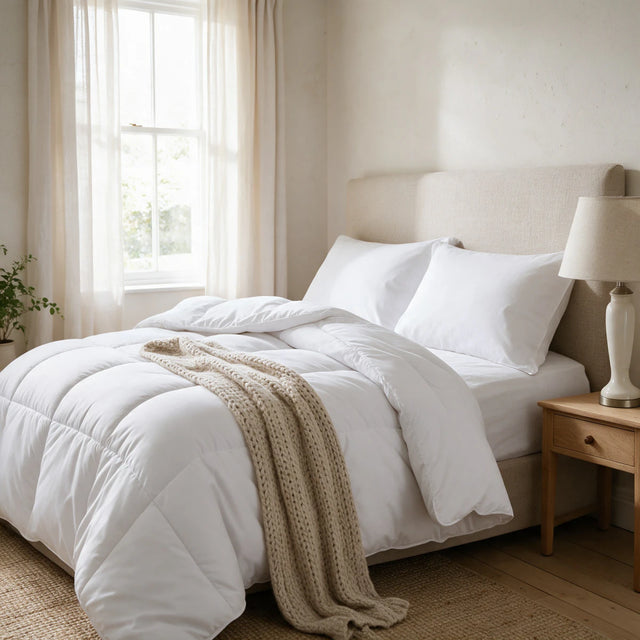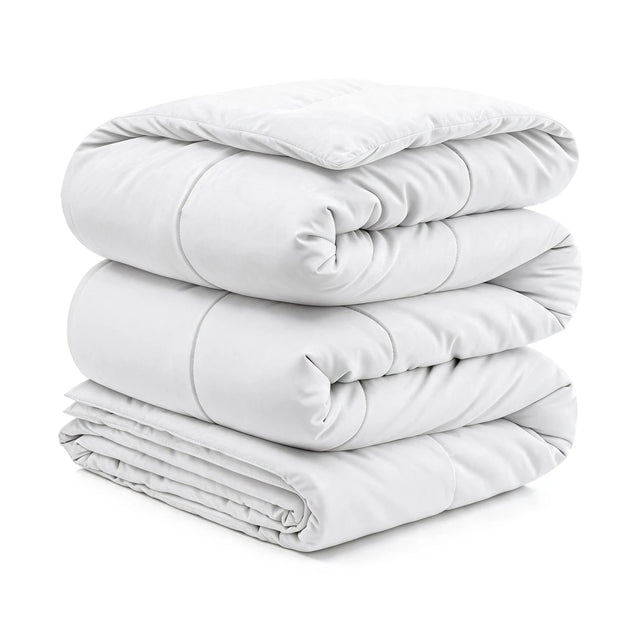
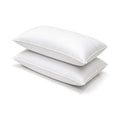
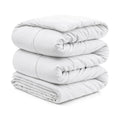
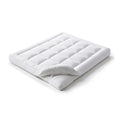

A tog is a unit of thermal resistance that measures how well a duvet stops body heat escaping. The higher the tog, the warmer the duvet. UK duvets run from 1 tog for hot summer nights to 15 tog for cold winter bedrooms. This guide covers where the word comes from, how tog is tested, whether a higher tog weighs more, and how to use the rating when you buy.
Here are the 7 common duvet tog ratings and what each one is for:
| Tog | Thermal resistance (m²K/W) | Use it for |
|---|---|---|
| 1 | 0.10 | Heatwaves and very hot sleepers |
| 2.5 | 0.25 | Warm summer nights |
| 4.5 | 0.45 | Summer and warm bedrooms |
| 7.5 | 0.75 | Spring and autumn |
| 10.5 | 1.05 | Most of the year in a heated home |
| 13.5 | 1.35 | Winter, rooms that cool at night |
| 15 | 1.50 | Cold or unheated bedrooms |
What does tog stand for?
Tog doesn't officially stand for anything. F. T. Peirce and W. H. Rees of the Shirley Institute, a textile research centre in Manchester, introduced the unit in 1946 and never explained the name. Collins and Chambers dictionaries both link it to "togs", the British slang word for clothes.
You'll sometimes see "thermal overall grade" given as the meaning. That's a backronym, a phrase invented afterwards to fit the letters, and it isn't in the original 1946 paper. Peirce and Rees modelled their unit on the clo, an American clothing insulation unit coined in 1941, and the short three-letter name probably copied that.
What is 1 tog equal to?
1 tog equals a thermal resistance of 0.1 square metre kelvin per watt (m²K/W). Put simply, a material rated 1 tog keeps a 0.1°C temperature difference between its two sides when 1 watt of heat flows through each square metre. Every tog rating is a multiple of that.
So a 10.5 tog duvet has a thermal resistance of 1.05 m²K/W, and a 13.5 tog duvet 1.35 m²K/W. The American clo unit equals 1.55 tog, which is why you'll rarely see clo on UK bedding: it's a clothing unit, and the numbers don't line up neatly with duvet weights.
How is tog measured?
Tog is measured in a laboratory with a Shirley Togmeter, which places the filling over a heated plate and records how much heat passes through it. The less heat that escapes, the higher the tog. The method is set out in British Standard BS 4745, so a 10.5 tog from one brand is tested the same way as a 10.5 tog from another.
The test is done on the duvet alone, without a cover. A duvet cover traps a thin extra layer of air, so a duvet in its cover is very slightly warmer than its label. British duvet tog ratings are also stated as minimums, so the real figure can be a little higher than the number on the pack.
What the test can't measure is your bedroom. A 10.5 tog duvet feels warmer in a centrally heated flat than in an old stone cottage, which is why the right tog depends on the room as much as the season. Our duvet tog guide for each season matches togs to rooms, and our guide to the best winter duvet tog covers 10.5, 13.5 and 15 tog in detail.

Does a higher tog mean a heavier duvet?
No, a higher tog doesn't have to mean a heavier duvet. Tog measures how much warm air the filling holds still, and a lofty filling holds more air for its weight than a dense one. That's why a down duvet can be warm and light at the same time.
A higher tog duvet is usually thicker, though, because more loft means more trapped air. Our microfibre duvet in 1 to 15 tog weighs about 1.2 kg to 2.2 kg depending on size. Its filling is hollowfibre, a polyester fibre with a hollow core that traps air inside each strand as well as between them.
Does a higher tog mean better quality?
No, tog says nothing about quality. It only measures warmth. A cheap duvet and an expensive one can share the same tog rating and feel very different, because the filling, the shell fabric, the stitching and how well the duvet keeps its loft after washing aren't part of the test.
For quality, look at what the filling is, whether it's stitched into channels or boxes so it can't drift into the corners, and the washing instructions. Feather and down duvets sold in the UK carry a filling label under BS EN 12934, which lists the materials by percentage of weight in decreasing order. Our guide to duvet fillings compared goes through each one, and how often to replace a duvet covers the signs it's worn out.
Do two duvets together add up their togs?
Yes, two duvets laid together roughly add their tog ratings, because thermal resistance in layers adds up. All-season duvets use this: a 4.5 tog and a 9 tog duvet fasten together with poppers to make a 13.5 tog winter duvet, and come apart for summer and autumn.
The same arithmetic works with a blanket or throw on top of a duvet, though blankets aren't usually tog rated, so you can't know the exact total.
Is tog used for anything other than duvets?
Yes, tog is also used to rate baby sleeping bags, sleeping bags for camping and some clothing. Baby sleeping bags are the most common example in the UK, sold in ratings such as 0.5, 1, 2.5 and 3.5 tog. A baby sleeping bag replaces a duvet for babies under 12 months, who shouldn't have a duvet, according to the NHS and The Lullaby Trust.
Tog ratings across products aren't directly comparable in feel, because a sleeping bag is worn and a duvet is laid over you. Compare like with like: duvet against duvet, sleeping bag against sleeping bag.
Which tog should you start with?
Start with 10.5 tog if you're not sure. It's the middle of the UK range and suits a centrally heated bedroom for most of the year. Hot sleepers and summer buyers go down to 4.5 tog, and cold rooms go up to 13.5 or 15 tog. Our guide to the 10.5 tog duvet explains when it's enough.
Our microfibre duvet comes in all 7 togs in the table above, from single to super king, with 1 tog in double and king only. Children's duvets are a smaller size, 120x150 cm, and ours come in 4.5, 7.5 and 9 tog.
Written by the Adam Home team in the UK.