

Pillows turn yellow because sweat, skin and hair oil, saliva, moisture from wet hair and leftover face cream soak through the pillowcase into the filling, and the fats, proteins and salts in that build-up go yellow or brown as they age. Pillow yellowing is a discolouration of a pillow's cover and filling caused by body soils that build up night after night. This guide covers the 5 causes, a 5-step whitening method, which fillings can be washed, chlorine versus oxygen bleach, whether a yellow pillow is safe to sleep on, and what a zipped protector does.
Why do pillows go yellow?
Pillows go yellow because moisture and oils from your body pass through the pillowcase every night and stay there. The Sleep Foundation names moisture as the main factor, and Good Housekeeping says the fats, proteins and salts in body soils yellow as they age.
There are 5 causes the two sources name between them:
- Sweat. Moisture from your head and neck soaks in through the night.
- Skin and hair oil. Sebum from overactive sebaceous glands soaks into the pillow, according to the Sleep Foundation, and Good Housekeeping lists hair oil next to skin oil.
- Saliva. Drool adds more moisture, and the Sleep Foundation links it to allergies, acid reflux and teeth grinding.
- Wet hair. Going to bed after a night-time shower puts water straight into the filling.
- Skincare. Lotions and face creams that haven't sunk in before bed seep into the pillow, the Sleep Foundation says, and Good Housekeeping suggests skipping heavy lotions and conditioners at night.

None of this shows on day one. The colour builds up slowly, which is why an old pillow can look yellow under a clean white case.
How do you get the yellow out of pillows?
To get the yellow out of pillows, pretreat the stains, soak the pillows in oxygen bleach, machine wash them and dry them right through. The 5 steps below follow the Good Housekeeping Institute's method, and each one stays inside the care label.
- Read the care label. Fillings wash differently, and solid memory foam shouldn't go in the machine at all. Cleanipedia advises testing any stain treatment on a hidden patch first.
- Pretreat the darkest patches. Put an enzyme stain remover on the yellow spots and leave it for at least 15 minutes.
- Soak in oxygen bleach. Fill a bath or large basin with water, add oxygen bleach at the dose on the tub, and leave the pillow under for 4 to 8 hours. Good Housekeeping uses hot water, so only go that hot if the label allows it.
- Wash two pillows at a time. Use warm water and an enzyme detergent, within the label's limit, and add an extra rinse to clear the soak out of the filling.
- Dry them all the way through. Tumble on the heat the label gives, stop a few times to fluff the pillows, and add dryer balls to stop the filling clumping.

Our own hollowfibre pillows are listed as machine wash cool with mild detergent, tumble dry low, so keep the soak and the wash cool for those, whatever a general guide says. If you can, finish the drying outdoors. Which? says drying bedding in sunlight helps kill micro-organisms living on it. The full machine method, with spin and drying times, is in our guide to washing pillows without clumping.
Which pillows can you whiten in the washing machine?
Hollowfibre, polyester fibre and most feather pillows can go in the washing machine if the label says so, while solid memory foam can't. The table sets out what Good Housekeeping and the Sleep Foundation say for each filling.
| Filling | Machine wash? | How to lift yellowing |
|---|---|---|
| Hollowfibre or polyester fibre | Yes, if the label allows | Full 5 steps. Our hollowfibre pillows: machine wash cool, mild detergent, tumble dry low |
| Duck feather and down | Often, but some are dry clean only | Cool or warm water only, since hot water can damage feathers (Sleep Foundation). Dry on the lowest heat over several cycles. Our duck feather pillows: cold water, dry thoroughly |
| Shredded memory foam | Hand wash, if the maker allows | Room-temperature water and mild detergent, rinse until clear, air dry (Sleep Foundation) |
| Solid memory foam | No, and don't soak it | Spot clean the foam, sprinkle bicarbonate of soda for smells and vacuum it off (Sleep Foundation). Wash the removable cover |
Foam is the one to be careful with. Good Housekeeping says a solid foam pillow can't be submerged, so the yellow on the foam itself mostly stays, and the cover is the part you can whiten.
Should you use bleach on a yellow pillow?
No, ordinary chlorine bleach isn't the right choice for yellow pillows, because Cleanipedia says chlorine bleach reacts with the proteins in sweat and makes the fabric darker. Oxygen bleach is the type Good Housekeeping uses for its pillow soak.
Oxygen bleach is a non-chlorine laundry bleach, and brands such as OxiClean and Vanish contain sodium percarbonate, a compound that releases hydrogen peroxide when it dissolves in water, according to Wikipedia. Look for the triangle on the care label before you buy a tub. GINETEX, the international care labelling association, says an empty triangle allows any bleach, a triangle with two oblique lines allows oxygen bleach only, and a crossed-out triangle means no bleach at all.
Is it OK to sleep on a yellow pillow?
Neither the Sleep Foundation nor Good Housekeeping calls a yellow pillow harmful, but both link the build-up behind the yellow to dust mites and bacteria. The Sleep Foundation says dust mites, mildew and other allergens can collect, especially in pillows damaged by moisture.
Allergy UK says house dust mites feed on the dead skin cells we shed and prefer warm, humid places such as bedding, and that washing at 60°C or above kills them, where the label goes that high. The Sleep Foundation also says sweat, oil and dead skin can clog pores, and that bacteria build up over time. It names excessive discolouration as a reason to replace a pillow, and our guide on how often to replace pillows has the fold test and 6 other signs.
Do pillow protectors stop yellowing?
Yes, a pillow protector slows yellowing, because it sits between the pillowcase and the pillow and catches sweat and oil before they reach the filling. Good Housekeeping recommends a washable protector to stretch the time between full pillow washes.
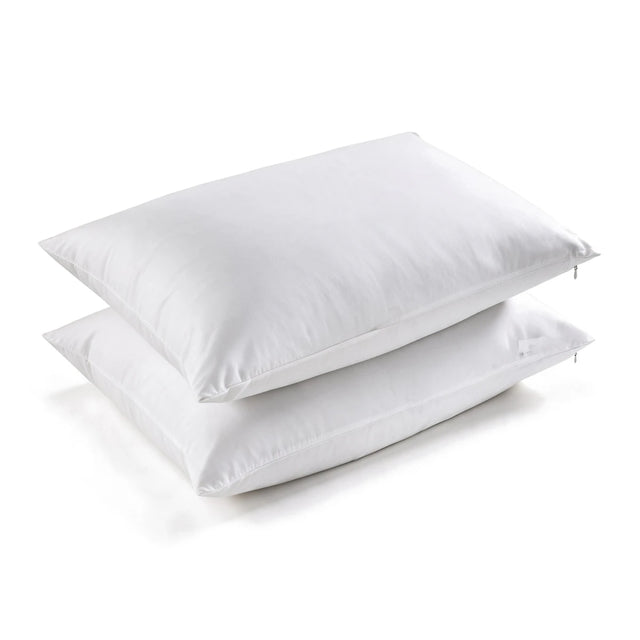
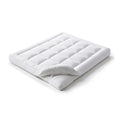
A pillow protector is a cover that fully encloses the pillow under its case, and the Sleep Foundation describes it as a sealed layer that blocks moisture. A full zip matters here, because a flap opening leaves a gap. Our zipped pillow protectors come in 2 kinds, both 50x75 cm with a full zip and from £9.99 for 2.
The first is the quilted pillow protector, with a "tightly woven polycotton" diamond-quilted shell and anti-allergy filling, machine wash at 40°C and tumble dry low. Its listing says the pillow inside "stays clean years longer than an uncovered one". The second is the microfibre pillow protector, made of 100% brushed microfibre, "anti-allergy and anti-bacterial treated", machine wash and dry.
A 40°C protector wash is a lot quicker than a 4 to 8 hour pillow soak. What a protector won't do is reverse yellowing that's already there, so whiten the pillow first, then cover it. Sizes, zips and pack numbers are covered in our guide to what a pillow protector is and whether you need one.
How do you stop pillows going yellow?
To stop pillows going yellow, wash pillowcases weekly, wash the pillows every 3 to 6 months, and keep a protector on each one. All 3 habits come from Good Housekeeping's cleaning lab.
Which? gives 4 to 6 months between washes for feather, down and microfibre pillows. Two more habits from Good Housekeeping cut the moisture at the source: shower in the evening, and make sure your hair is fully dry before you lie down. Our pillowcases are listed as machine washable at 40°C, so a weekly wash fits straight into the normal laundry.
Written by the Adam Home team in the UK.